01 — THE BUSINESS
Le Bien Home Care is a non-medical home care provider launching in Pittsburgh, Pennsylvania, part of the Le Bien maison — the same group behind Le Bien Planner Deco, already supported by RIXZA on events. The offer covers seven service categories (companionship, personal care, homemaking, respite, senior support, post-hospital support, memory support). At launch, the practice has no client history and no published reviews: trust cannot rest on any past proof.
02 — BEFORE RIXZA
No digital presence existed before this project — no site, no visual identity, no content. The US home-care sector is dominated by clinically toned sites with near-interchangeable service lists — the format a family meets at almost every provider, regardless of actual quality.
03 — THE PROBLEM
TRUST PROBLEM
Handing a parent's care to a stranger is an emotionally loaded decision. A family comparing providers is not comparing prices — they are working out who they can trust. With no history, no reviews, no before/after to show, that trust has to be built entirely in how the experience presents itself, before the first phone call.
04 — WHAT RIXZA SAW
RIXZA reading
OBSERVATION
Sites in this category almost all default to the same clinical tone and the same generic service list.
ROOT CAUSE
The format inherited from the medical sector signals seriousness, but read by a worried family it lands as cold rather than reassuring.
BUSINESS IMPACT
A new entrant reproducing that format blends into the crowd, without the reputation established competitors already carry.
OBSERVATION
Le Bien Home Care had no client reviews or service history at launch.
ROOT CAUSE
The practice is a new venture: credibility cannot be built on past results.
BUSINESS IMPACT
Every usual proof point (reviews, before/after, tenure) was absent by construction, not by oversight.
OBSERVATION
Families arrive with specific practical questions: cost, insurance, geographic coverage, overnight availability.
ROOT CAUSE
These questions are not incidental — they determine whether the service is even viable for that family.
BUSINESS IMPACT
An unanswered practical question becomes a silent reason to call a competitor instead.
05 — OPPORTUNITY MAP
01
Build trust without leaning on client reviews — since none exist at launch.
02
Differentiate visually from the sector's dominant clinical codes.
03
Structure the offer around seven named needs rather than a list of services.
04
Address sensitive practical questions without ever stating unconfirmed information as fact.
05
Reduce friction at first contact, at the exact moment intent forms.
06 — STRATEGIC OPTIONS
OPTION A
A conventional sector-standard website
Present the practice and its services in the clinical format the home-care sector expects.
Reproduces the sector's coldness, without competitors' tenure
OPTION BSELECTED
An experience built on the family's journey
Organise the site around the questions a family actually asks, from first doubt to a care request.
Builds trust through clarity rather than social proof
OPTION C
A full client / caregiver platform
Scheduling portal, messaging and online billing from day one.
Disproportionate operational load before a client base even exists
07 — WHY WE CHOSE THIS APPROACH
Option C would have built management tooling before there was a single client to manage. Option A was the sector's expected format — meaning the format that does nothing to distinguish a new entrant from any other. We organised the site around a family's real questions — what do you do, how does it work, why should we trust you, what happens next — because that is the only proof of seriousness available before a first review exists.
08 — THE SOLUTION
STRATEGY
Positioning around clarity and honesty rather than the tenure credentials the practice doesn't yet have.
EXPERIENCE
Site architecture organised around a family's real journey: trust, understanding, services, process, people, action.
DESIGN
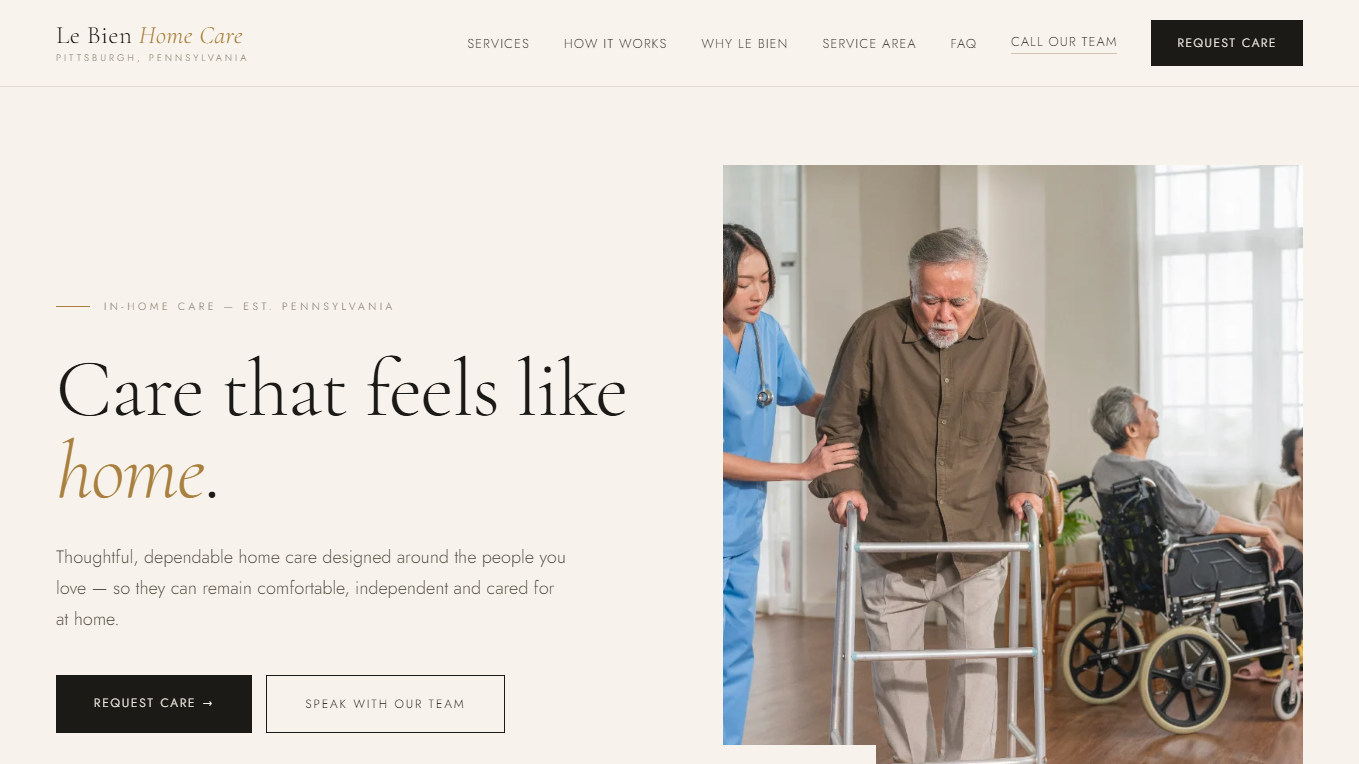
A warm editorial direction and natural photography, deliberately distanced from the sector's clinical aesthetic.
GROWTH
Local SEO foundations for Pittsburgh and Allegheny County, and a pre-filled WhatsApp request to shorten first contact.
09 — SOLUTION ARCHITECTURE
01Trust (the belief)
02Seven named services
03What sets Le Bien apart
04How it works — 4 steps
05The care team
06Service area
07FAQ
08Care request
10 — KEY DECISIONS
DECISION
Structure the offer into seven named categories rather than a generic service list.
REASON
A senior living alone and someone recovering after a hospital stay don't share a need; blending them forces the family to guess.
INTENDED EFFECT
Let a family recognise their exact need immediately.
DECISION
Publish no client reviews or satisfaction figures at launch — a 'testimonial pending authorization' placeholder is shown as-is.
REASON
No reviews exist yet; inventing them would have been the only way to fill that section, which the project rules out on principle.
INTENDED EFFECT
Protect long-term credibility over a launch-day facade.
DECISION
Address sensitive questions (cost, insurance, coverage, overnight care) in an honest FAQ rather than sales copy.
REASON
Price depends on an initial assessment, insurance and Medicaid vary by situation, and geographic coverage is confirmed case by case — presenting these as settled would have been inaccurate.
INTENDED EFFECT
Avoid a family discovering inaccurate information later, at the exact moment trust matters most.
DECISION
Make WhatsApp the first-contact channel, pre-filled from the request form.
REASON
A family that has just decided to ask for help doesn't want to fill out a generic contact form and then wait for an email reply.
INTENDED EFFECT
Shorten the gap between expressed intent and the first human exchange.
11 — IMPLEMENTATION
The site was built around a family's journey rather than the practice's org chart. Every section has a precise role in building trust, and none rests on proof the practice doesn't yet have.
—Seven named service pages
—4-step journey
—Decision-oriented FAQ
—Pre-filled WhatsApp care request
—Service area (Allegheny County)
12 — TECHNOLOGY STACK
WebsiteWhatsApp contactSEOAnalytics
13 — THE RESULTS
LEVEL 01 — LAUNCH
The project is delivered and live. Long-term commercial impact has not been measured yet.
LAUNCHED
Site delivered and live, structured around the family's journey rather than the practice's org chart.
IMPLEMENTED
Seven named services, a 4-step journey, a decision-oriented FAQ and a pre-filled WhatsApp request put in place.
NOT YET MEASURED
Request volume or conversion rate attributable to the site — not measured, the site having just launched.
The site went live recently: there is no prior traffic or conversion data to compare against, and no post-launch measurement has been carried out yet. The site's testimonial placements explicitly show a pending-authorization note rather than an invented quote, and the service-area list is presented as confirmed case by case rather than final.
14 — QUALITATIVE OUTCOMES
Qualitative outcome
—A family can recognise their exact need on the services page, without guessing whether their case applies.
—The tone deliberately avoids the clinical register that dominates the home-care sector.
—Sensitive practical questions (cost, insurance, coverage) are addressed directly, without unverifiable promises.
15 — WHO DID WHAT
WHAT RIXZA DELIVERED
—Positioning strategy
—Brand identity and editorial direction
—Information architecture and family journey
—UX/UI and design
—Website development
—SEO and analytics foundations
WHAT THE CLIENT OWNED
—Defining the seven services and their operational content
—Hiring and training caregivers
—Handling incoming requests
—Delivering the care service
16 — WHAT WAS HARD
Making a brand credible with no client reviews or history to show, in a sector where the buying decision rests entirely on trust.
HOW WE SOLVED IT
Trust was built through the clarity of the content rather than absent social proof: practical questions are addressed head-on, testimonial placements show a pending-authorization note rather than a fabricated example, and geographic coverage is presented as confirmed case by case rather than asserted outright.
17 — WHAT WE LEARNED
When a brand has no social proof yet, the honesty and clarity of the content itself becomes the proof of trust.
18 — WHAT THIS PROJECT PROVES
This project demonstrates RIXZA's ability to build brand credibility from launch, without leaning on data, reviews or results that don't exist yet.